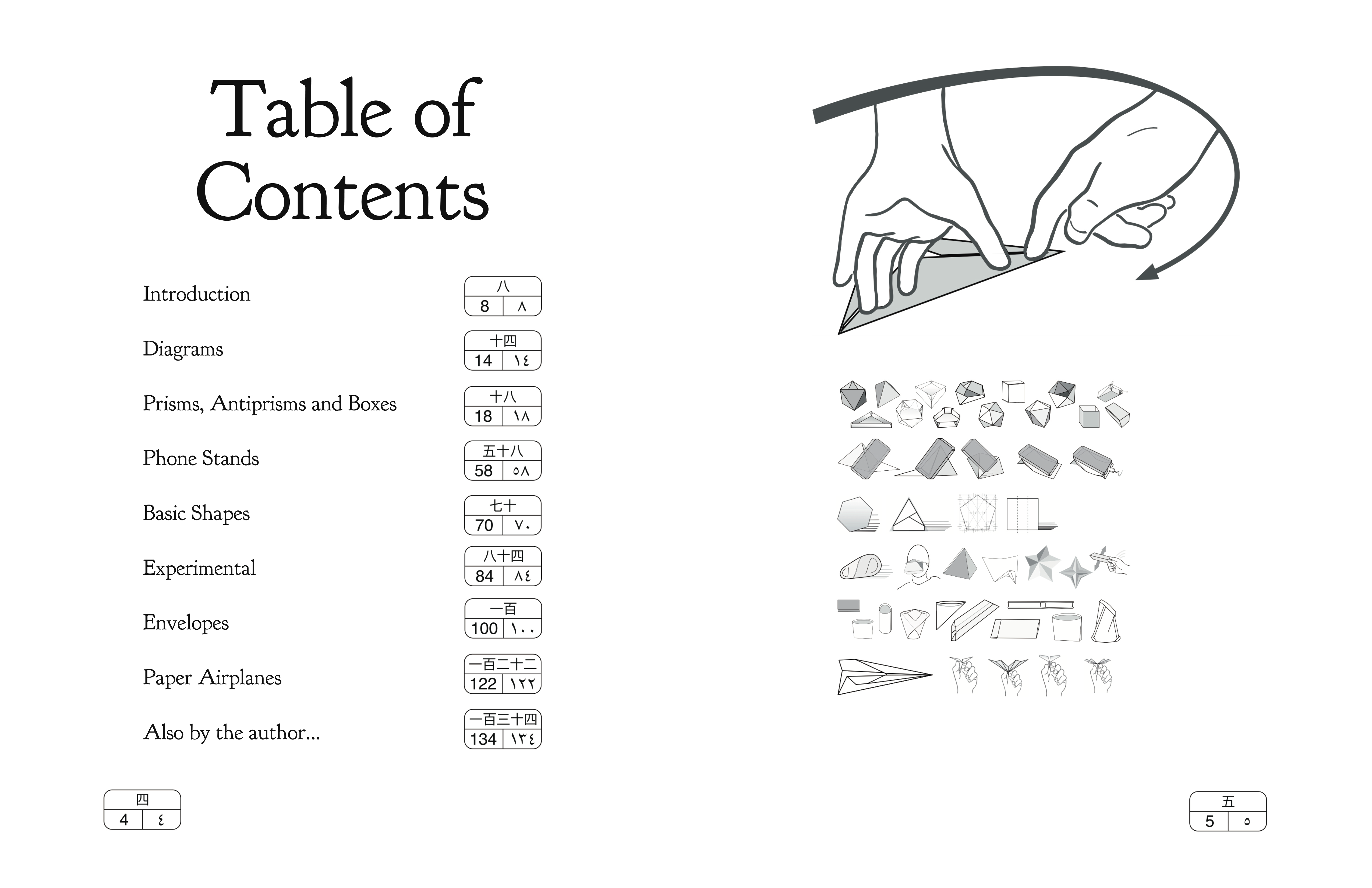
Useful objects
Packages, planes, phone stands and other functional designs made from readily available paper.
Clear diagrams
Step-by-step illustrations use the familiar Yoshizawa–Randlett language of modern origami.
Design insight
Background stories, folding commentary and helpful observations accompany the original models.
Introduction
Inventions played an important part in the creation of this book. My first invention was an original origami paper airplane I folded around age ten. At the time origami diagrams made no sense to me.
Many inventions and two patents later, my starch based dilatant composition, Oozeq, needed a biodegradeable paper package. An hour of twisting and squishing paper turned into an interesting little pyramid. It seemed like there was some pattern in the way the paper wrapped around on itself. Multiple hours of reverse engineering and refinement resulted in my second original origami design.
Sharing this pyramid with experienced origami designers, it became evident that I had designed something new. Encouraged to submit this for publication, I found it necessary to diagram the design using a shared standard set of symbols in a generally recognizable format. My efforts are documented in my diagram number 00, Open Triangular Antiprism from Equilateral Triangle, and number 01, Tetrahedron from Triangular Open Antiprism.
Designing an origami diagram first hand proved useful, as there is so much being communicated. Learning about the Yoshizawa–Randlett system of diagramming allowed me to craft the visual presentation directly, making nuanced and subjective design decisions. This also developed my understanding of the mechanics of origami, leading to further original designs.
The diagram for my first design—number 13, Paper Airplane from Rectangle—finally arrived some 40 years late and was published in the Pacific Coast OrigamiUSA Conference 2023 collection, page 11.
Triangles bind the designs presented here with a common thread. Some are obviously based on a single equilateral triangle, while others are inspired by or incorporate some aspect of a triangular form.
While we’re on the topic of two dimensional geometric shapes, hexagons are going to be the next big thing—they're going to be everywhere. That's what I was saying years ago, and now the trend has arrived.
Hexagons were not easy to find in arts and crafts stores in 2017. This then uncommon shape, built of triangles, presented a fun opportunity for original origami designs.
Mathematics is the ideal path to determine the largest regular hexagon that can be drawn inside a square. Avoiding math, I worked through a process of guessing and folding, unfolding and tweaking, and a pattern gradually emerged. My trial and error folding eventually arrived at the same conclusion as basic geometry. In the process I documented a series of folds, in half and half again, and the hidden symmetry of my hexagon design emerged.
Shuzo Fujimoto of Japan, 1922-2015, engineered many original designs including a direct alternative to my hexagon design. Where his design calculated an angled fold to define the edges of the hexagon, I stumbled upon a combination of perpendicular and parallel folds halfway between previously defined points. Folding things in half and in half again seems an elegant and accurate method for defining where folds should be made. Perhaps others will be interested in this approach, documented in my diagram number 38, Maximal Hexagon from Square.
Even pentagons can be defined as intersections of X and Y at intervals of halves. Talk about not obvious, this one barely made any sense at all.
Sometimes it’s easier to create new things without the tools and methods that arrived at old things. Geometry arrived at old ways of folding a regular pentagon from a square. Building on my strengths, I once again took the path that avoided math and searched for some pattern in half and half again grid lines. Took some time and required some concentration to remember why seemingly arbitrary intersections in the grid were circled. Running through the sketches a few times eventually saw the diagram begin to make sense. While other ways may get similar results, Pentagon Halves and Intersections documented in my diagram number 20 presents an accurate regular pentagon that starts with folding a square of paper in half followed by equally straightforward subsequent steps. I’m starting to see patterns in all this geometry.
accessible text
Right-hand page text
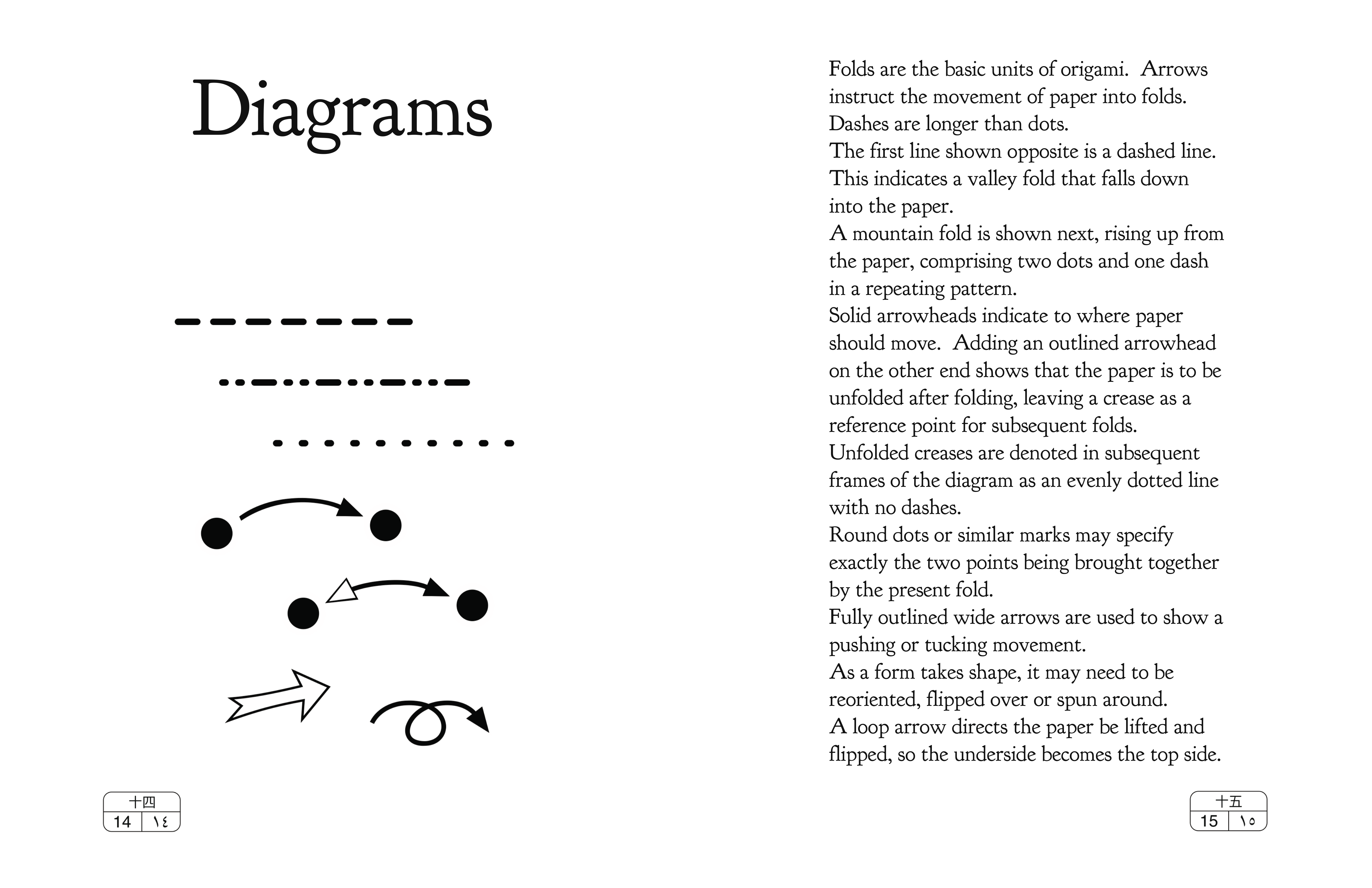
Folds are the basic units of origami. Arrows instruct the movement of paper into folds.
Dashes are longer than dots.
The first line shown opposite is a dashed line. This indicates a valley fold that falls down into the paper.
A mountain fold is shown next, rising up from the paper, comprising two dots and one dash in a repeating pattern.
Solid arrowheads indicate to where paper should move. Adding an outlined arrowhead on the other end shows that the paper is to be unfolded after folding, leaving a crease as a reference point for subsequent folds.
Unfolded creases are denoted in subsequent frames of the diagram as an evenly dotted line with no dashes.
Round dots or similar marks may specify exactly the two points being brought together by the present fold.
Fully outlined wide arrows are used to show a pushing or tucking movement.
As a form takes shape, it may need to be reoriented, flipped over or spun around.
A loop arrow directs the paper be lifted and flipped, so the underside becomes the top side.
accessible text
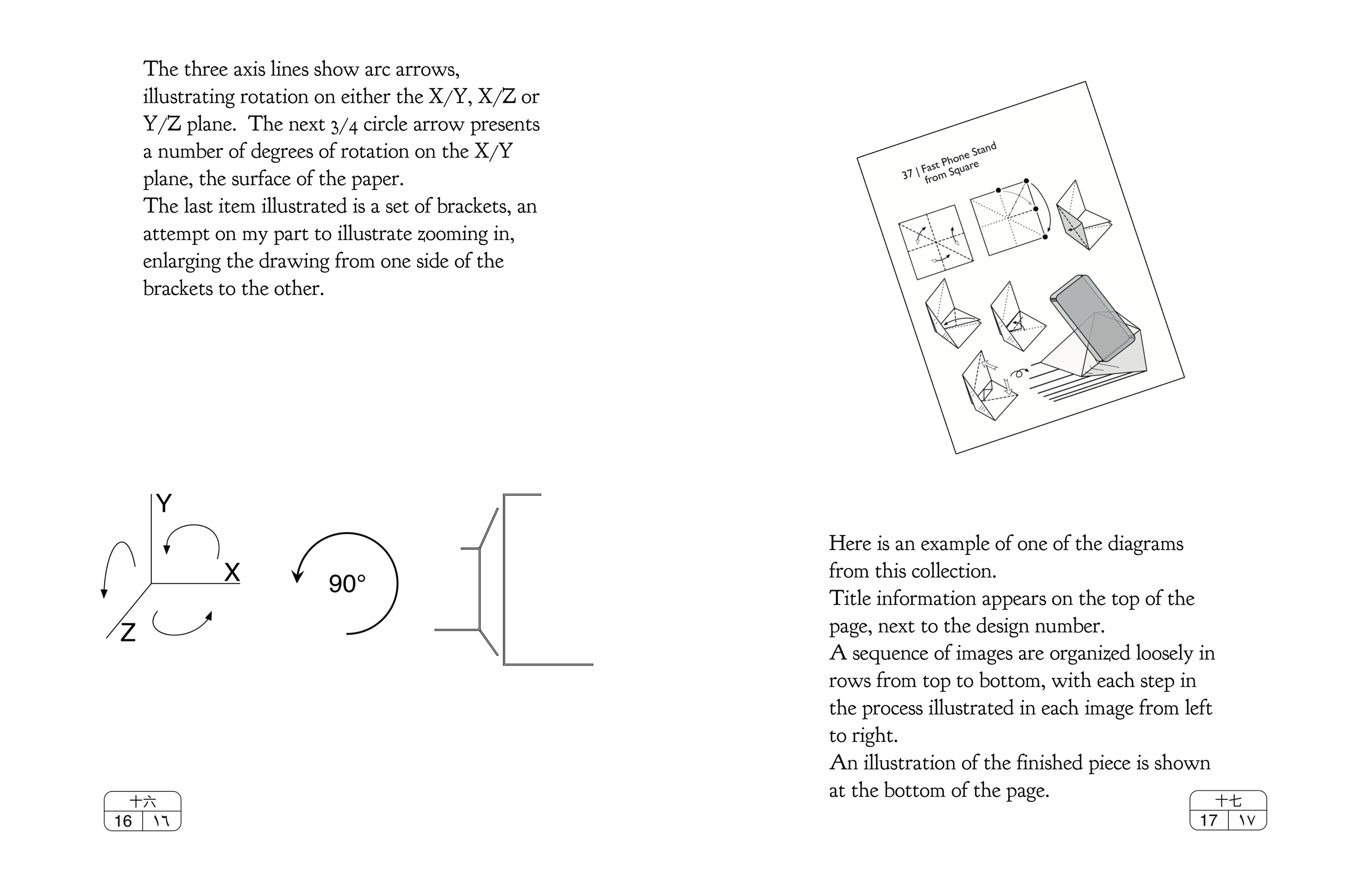
The three axis lines show arc arrows, illustrating rotation on either the X/Y, X/Z or Y/Z plane. The next 3/4 circle arrow presents a number of degrees of rotation on the X/Y plane, the surface of the paper.
The last item illustrated is a set of brackets, an attempt on my part to illustrate zooming in, enlarging the drawing from one side of the brackets to the other.
Here is an example of one of the diagrams from this collection.
Title information appears on the top of the page, next to the design number.
A sequence of images are organized loosely in rows from top to bottom, with each step in the process illustrated in each image from left to right.
An illustration of the finished piece is shown at the bottom of the page.
accessible text
Right-hand page text
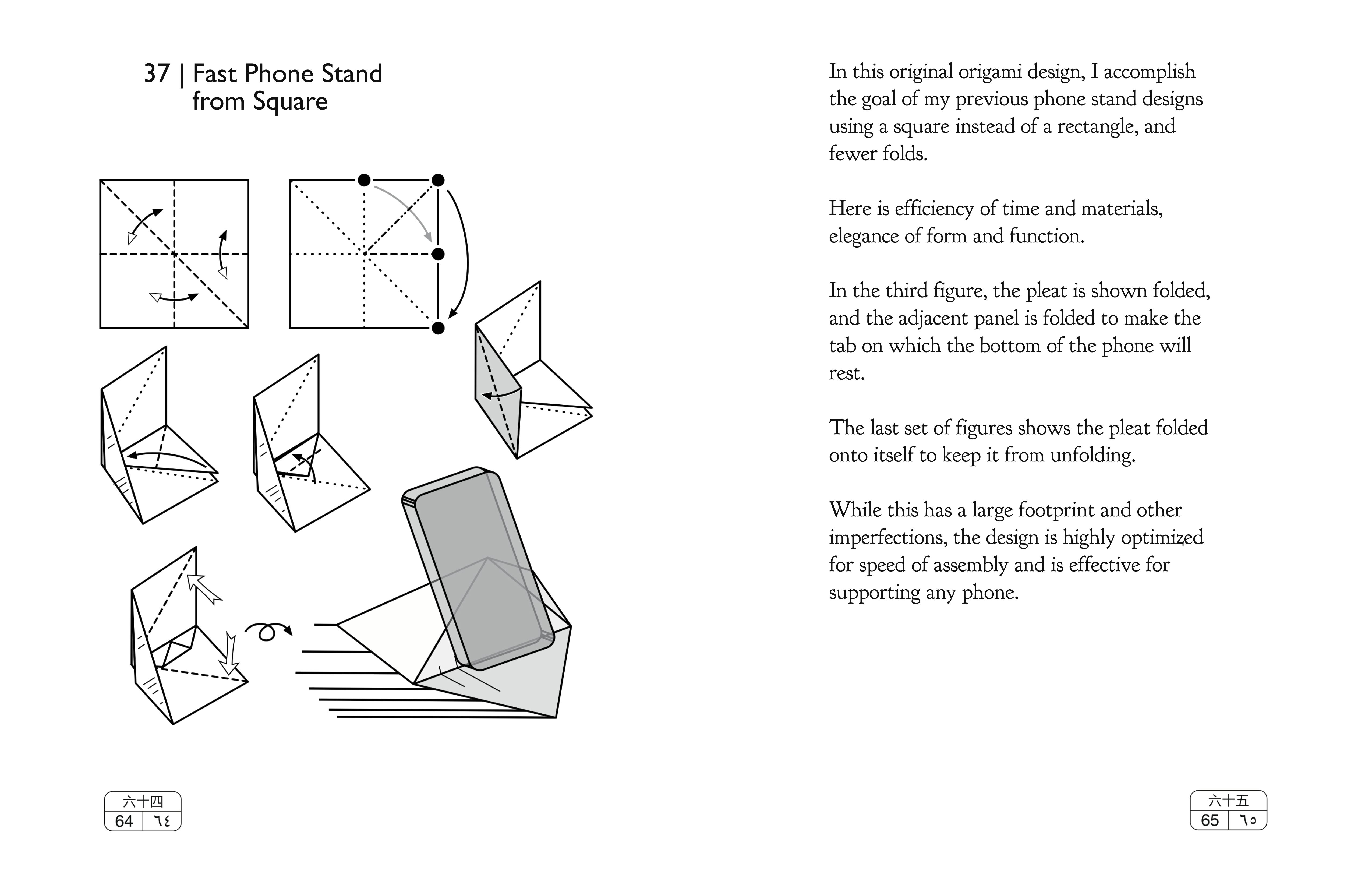
In this original origami design, I accomplish the goal of my previous phone stand designs using a square instead of a rectangle, and fewer folds.
Here is efficiency of time and materials, elegance of form and function.
In the third figure, the pleat is shown folded, and the adjacent panel is folded to make the tab on which the bottom of the phone will rest.
The last set of figures shows the pleat folded onto itself to keep it from unfolding.
While this has a large footprint and other imperfections, the design is highly optimized for speed of assembly and is effective for supporting any phone.
accessible text
Right-hand page text
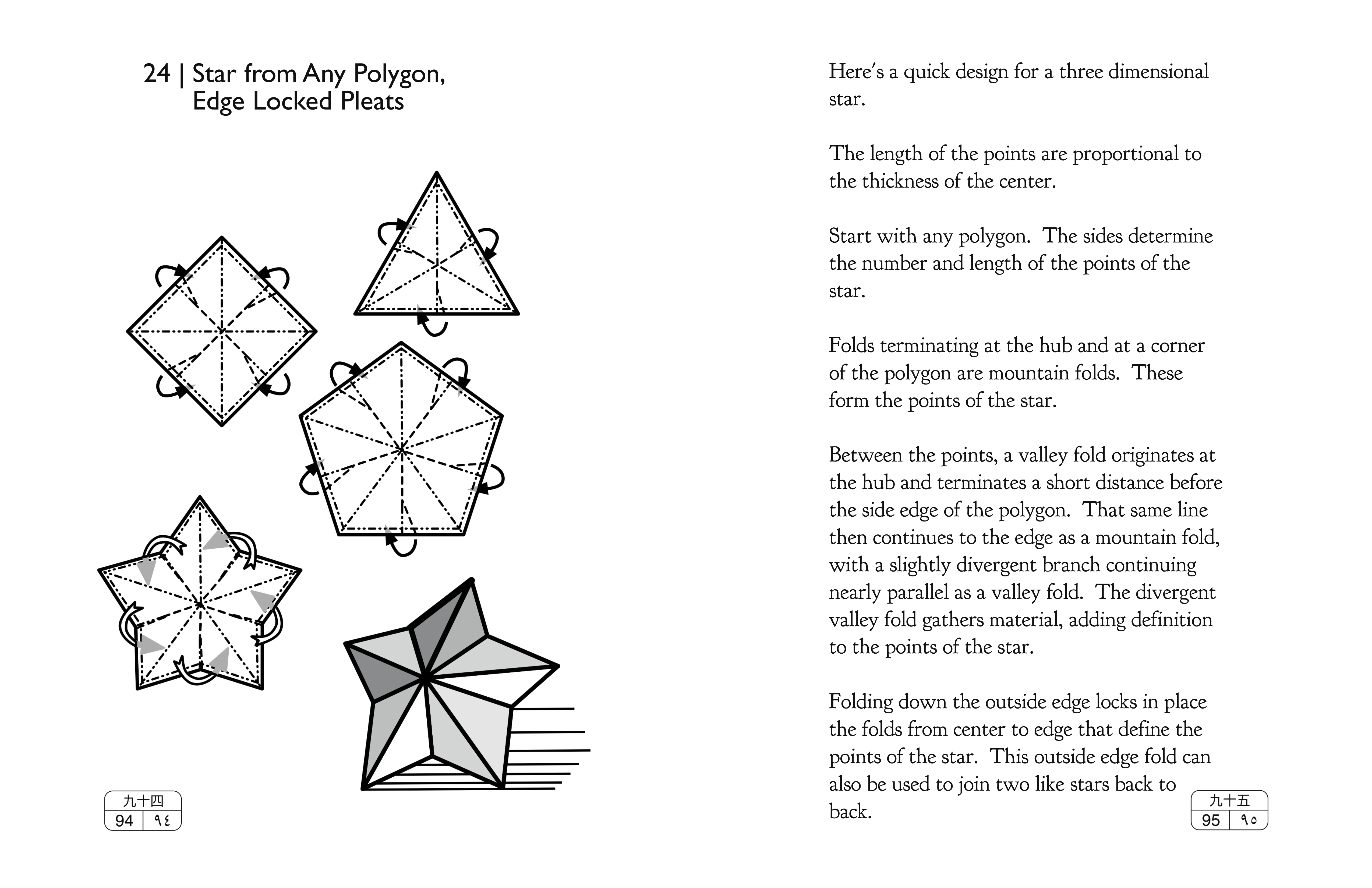
Here's a quick design for a three dimensional star.
The length of the points are proportional to the thickness of the center.
Start with any polygon. The sides determine the number and length of the points of the star.
Folds terminating at the hub and at a corner of the polygon are mountain folds. These form the points of the star.
Between the points, a valley fold originates at the hub and terminates a short distance before the side edge of the polygon. That same line then continues to the edge as a mountain fold, with a slightly divergent branch continuing nearly parallel as a valley fold. The divergent valley fold gathers material, adding definition to the points of the star.
Folding down the outside edge locks in place the folds from center to edge that define the points of the star. This outside edge fold can also be used to join two like stars back to back.
accessible text
Right-hand page text
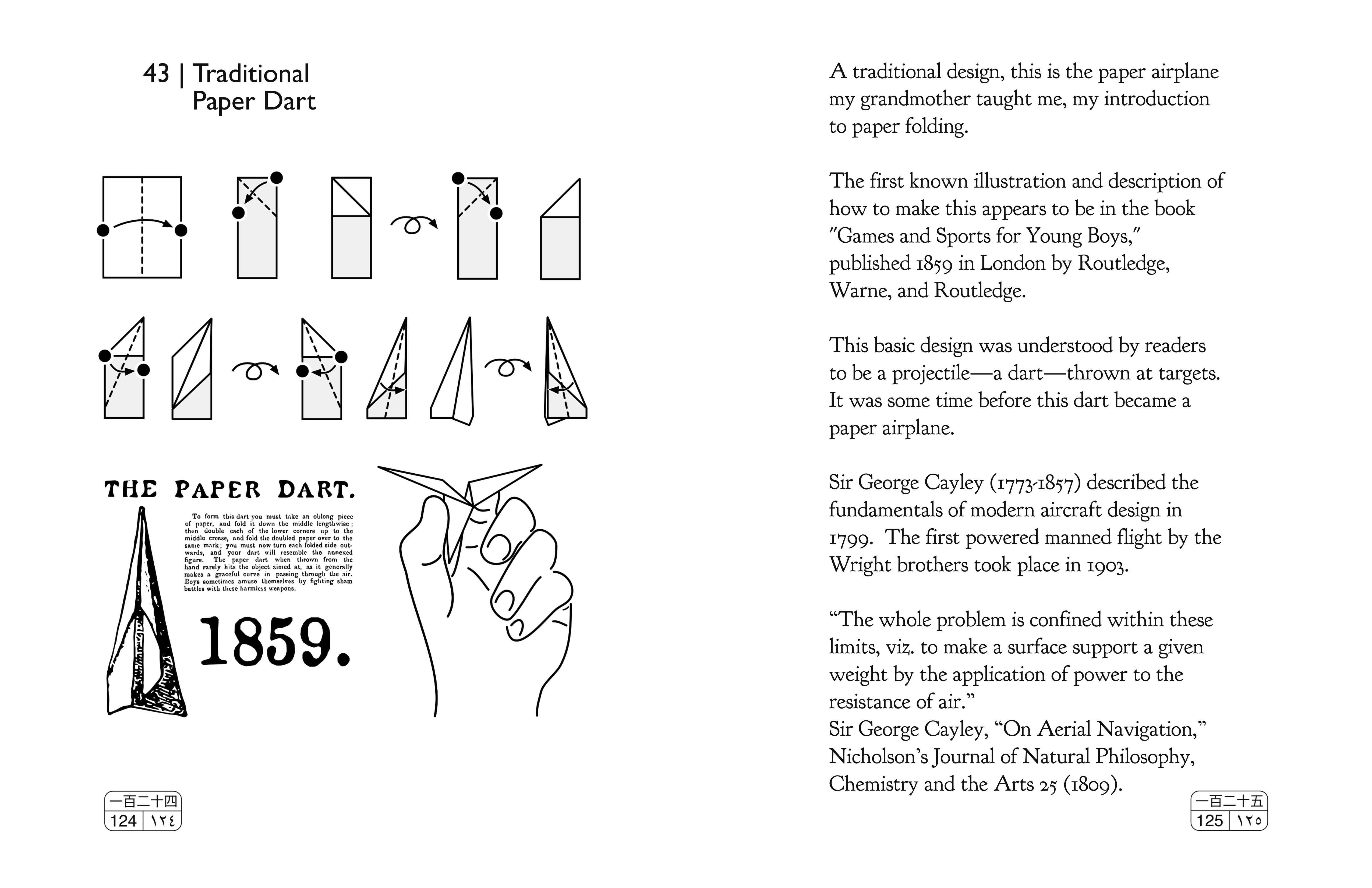
A traditional design, this is the paper airplane my grandmother taught me, my introduction to paper folding.
The first known illustration and description of how to make this appears to be in the book "Games and Sports for Young Boys," published 1859 in London by Routledge, Warne, and Routledge.
This basic design was understood by readers to be a projectile—a dart—thrown at targets. It was some time before this dart became a paper airplane.
Sir George Cayley (1773-1857) described the fundamentals of modern aircraft design in 1799. The first powered manned flight by the Wright brothers took place in 1903.
“The whole problem is confined within these limits, viz. to make a surface support a given weight by the application of power to the resistance of air.”
Sir George Cayley, “On Aerial Navigation,” Nicholson’s Journal of Natural Philosophy, Chemistry and the Arts 25 (1809).
Triangle Origami Book
William Zicker
Second edition · 2026
ISBN 9780984265534